
In Morocco, the sun shines an average of over 300 days a year. This chronic UV exposure is the leading cause of premature skin ageing, dark spots, and barrier damage. Yet sunscreen remains the most underused skincare product. Here's everything you need to know to change that habit.
The Moroccan sun and your skin: the scientific reality
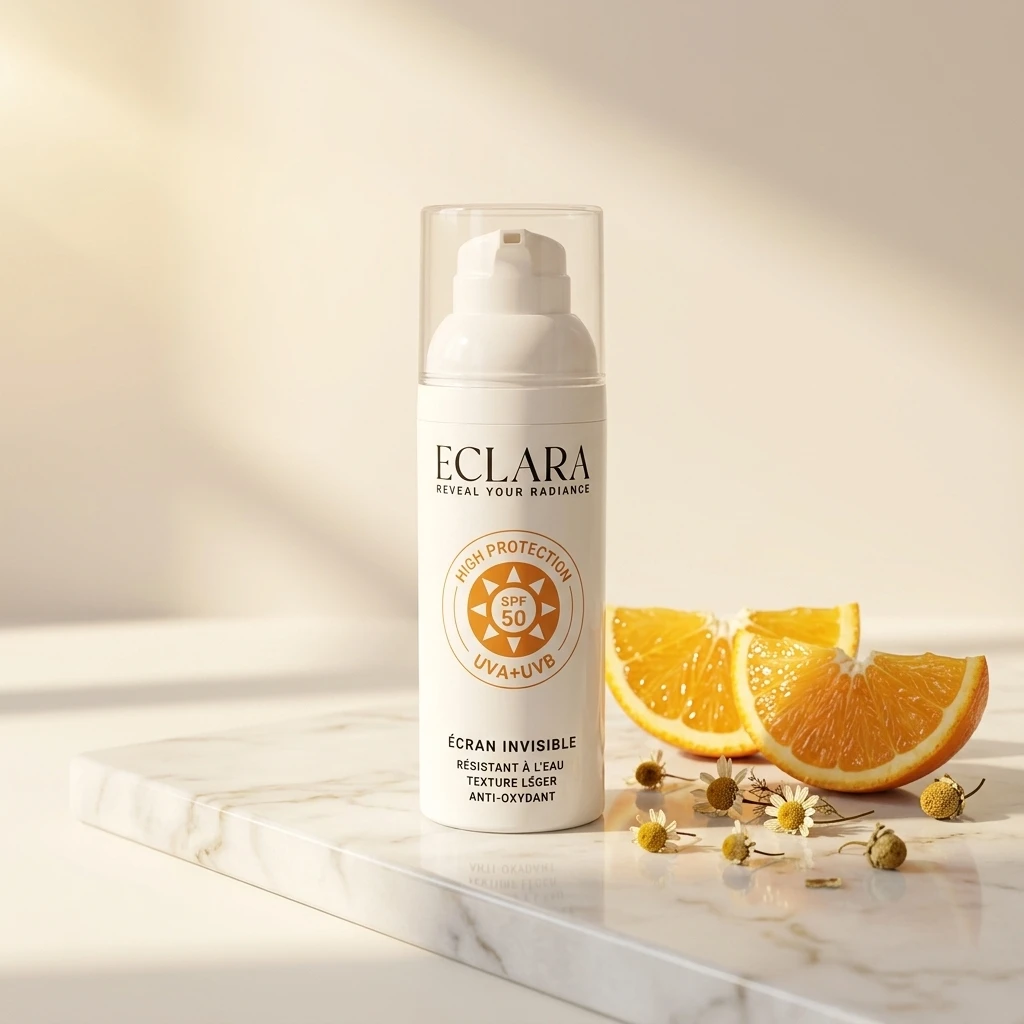
UV rays split into two types. UVB causes sunburn and skin cancer. UVA — which penetrate glass and remain present even on cloudy days — cause skin ageing and hyperpigmentation. In Morocco, the UV index regularly exceeds 10 (extreme) from March to October. SPF50 blocks 98% of UVB, but "broad spectrum" or "PA++++" labelling is what guarantees UVA protection.
The invisible daily damage from UV rays
The problem with UV is it works silently. Damage accumulates over years before becoming visible: premature wrinkles, enlarged pores, age spots, loss of elasticity. Women with higher phototypes (olive or dark skin) often think they're naturally protected — they're not. Melanin offers protection equivalent to SPF4 at most, which is far insufficient under Morocco's sun.
How to apply SPF50 correctly
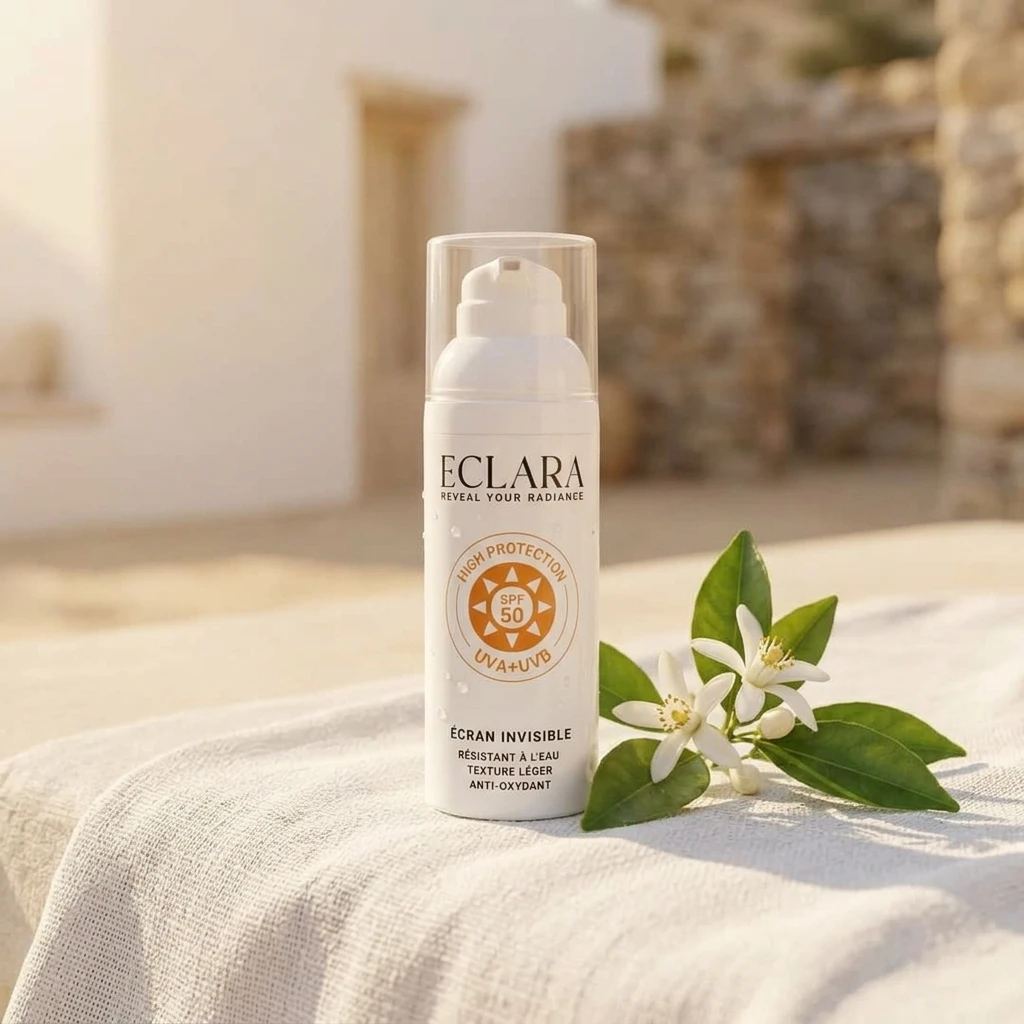
The amount matters as much as the product. Dermatological standard: 2 mg/cm² — roughly a level teaspoon for the face alone. Apply Eclara's SPF50 Sunscreen as the last step of your morning routine, after moisturiser. Allow 10-15 minutes to absorb before going outside. Reapply every 2 hours during prolonged exposure.
SPF in winter: myth or reality?
Absolute reality. UVA intensity is nearly constant year-round — it doesn't drop in winter. Even in December in Casablanca, UVA levels are significant. Atlas mountain snow reflects up to 80% of UV rays. Winter SPF is not optional — it's a 365-day protection habit.
Complete morning routine with sun protection
The ideal 4-step routine: 1) Gentle cleanser, 2) Active serum (vitamin C or niacinamide), 3) Light moisturiser, 4) SPF50 sunscreen. This sequence takes under 5 minutes and shields your skin from the two main ageing accelerators: UV rays and free radicals.
Protection levels compared
| Sunscreen | % of UVB blocked | Protection verdict |
|---|---|---|
| SPF 15 | 93 % | Not enough under the Moroccan sun |
| SPF 30 | 96.7 % | Fine for short exposure |
| SPF 50 | 98 % | The daily standard in Morocco |
| SPF 50+ | 98 % and above | Best for fair skin, melasma or peak summer |
On filters, two families coexist. Chemical filters (avobenzone, Tinosorb, Uvinul) absorb UV and deliver light, invisible textures that make applying enough product easy — that is why they dominate facial formulas. Mineral filters (zinc oxide, titanium dioxide) reflect light: better tolerated by very reactive skin, but often leaving a white cast. The "broad spectrum" claim or a PA++++ rating is the only guarantee of real UVA protection — the SPF number only speaks for UVB.
How to choose the right sunscreen for your skin
- Oily or acne-prone skin: fluid or gel texture, "oil-free" or mattifying finish; avoid heavily loaded mineral filters that feel occlusive.
- Dry skin: rich cream texture with glycerin or squalane near the top of the INCI list.
- Deep or medium-deep skin tones: look for "no white cast" formulas; modern invisible screens leave zero veil.
- Sensitive skin or rosacea: mineral filters only, or soothing actives added.
- Specific need: melasma = broad-spectrum SPF 50+, 100 % of days a year; sports/outdoors = "water resistant" label.
Two options cover most needs: the classic SPF 50 sunscreen for daily comfort, and the invisible screen for skin that dislikes the feeling of sunscreen. In the morning the ideal order remains: antioxidant serum, moisturizer, then SPF — the antioxidant catches the free radicals the filter lets through.
The 3 sun myths that cost a skin
- "It's cloudy, no need." Overcast skies still let up to 80 % of UVA through — that December terrace afternoon without protection counts double in the yearly bill.
- "My medium-deep skin is protected." Melanin is worth an SPF of 4 at best. Higher phototype delays sunburn, not photoaging or melasma — which hits medium-deep skin precisely.
- "I apply it in the morning, done." At 2 mg/cm² the rated protection lasts ~2 hours; a dab spread over the whole day acts at a tenth of its stated SPF.
The real habit change is not buying "the best" screen, but keeping a tube within reach — bag, desk, bathroom — to reapply 3 times a day in warm season. The fast-to-reapply SPF 50 texture, and the invisible format over makeup: that combination holds 365 days.
Reapplication without disrupting makeup
The objection we hear most from women who work outside the home is practical: how do you reapply SPF over makeup at midday? Three options work. First, an invisible UV mist sprayed at twenty centimeters — ten seconds, no streaks. Second, a cushion or compact with SPF, pressed rather than rubbed. Third, mineral powder with broad-spectrum filters for touch-ups of the T-zone, where the morning layer wears off first. None of these replaces the morning dose; they extend it. The rule of thumb: whatever format you pick, keep it in the bag you actually carry. Sunscreen stored at home during a twelve-hour day out protects nobody.
Source: World Health Organization